Gespräch · · 49:04
Gespräch mit Mustafa
Didem Yazıcı stellt den Künstler und Filmemacher Mustafa vor und spricht mit ihm über seine Arbeit (auf Englisch).
Mitschnitt · 49:04
Die Tondateien werden gerade umgezogen. Der Mitschnitt ist in Kürze wieder abspielbar, das Transkript können Sie schon jetzt lesen.
Transkript
Automatische Rohfassung · rund 5.800 Wörter
Automatische Transkription, nicht redigiert. Namen und Fachbegriffe können fehlerhaft sein. Das Gespräch wurde auf Englisch geführt.
Didem: Maybe some of you don't know who actually Mustafa is. So I would like to tell more about his biographical information. Mustafa is an artist and filmmaker who lives and works in Karlsruhe and Istanbul. He works with film, photography, sculpture and performance. His practice focuses on the agency and the truth making potentiality of the media infrastructures, particularly at political soundscapes. After working as director and assistant in film. His current practice mediating still and moving images, distracting meta narratives and decolonizing canonical history writing practices not only in theoretical but also in expanded settings. He is holding a B A in history from Boston University in Istanbul and a diploma in media arts from J F K K. Recently, he is in residence at Hungar Barcelona, focusing on video archives from the nineties dealing with the images of neo liberal violence produced during this era from a trans regional perspective. And who am I? I'm D M maybe some of you were actually also uh at my talk a few weeks ago here, but I'm an independent curation writer based between Istanbul and Karsa. And I'm very lucky because I to work with Mustafa now for few years. Um at the moment, there is a group exhibition in Istanbul Life, Death Love and Justice, where his work is in the exhibition. And we, we worked in a small solo exhibition of Mustafa last year in Mannheim, Maki, Mami Vata. And uh it's very pleasing because Mustafa is going to Netherlands soon for uh one we academy. But uh Kare is lucky that he will be back and forth between Netherlands and Germany. So welcome. Uh Mustafa. And um let's speak about the work. And I think like my first uh question will be, please tell our, tell the audience more about the local context because the city where you made this work is Mardin in Turkey, which is um Southeast of Turkey. So first, the local context,
Mustafa: Thanks for having me tonight. It's a pleasure to be here in my first week back in K Square after a very long summer. Um regarding the background of this work in 2015, between 2015 and 16, I was making an ma in visual arts in Marden at Art University. Uh Marden is in the southeast Turkey at the Syrian border across the cities of Kobane Hasse and Kamis. Uh nowadays, under the Northern Sea refederation, it's an autonomous region. And those cities uh the Marin is a very also multicultural city consisting of Kurdish Arab and Assyrian population. When I was like making my research for my ma there uh like three things, three phenomenon impressed me immediately. when I was like having my everyday life in that city. First of all, of course, the very heavy and violent history of that city, which is predominantly a Kurdish city which makes it politically quite insurgent. Since 1980 1978 there is a armed struggle against the Turkish military forces in that city. And this rebellion still continues today as also political struggle in the parliament. And it is a very violent and bloody let's say presence in the city, a lot of forcefully kidnapped people, forceful migration, political assassinations and so on and so forth. Of course, this super bloody and violent history also makes in everyday life, another presence somehow like those ghosts also haunt everyday life back and forth. That's why during my studies, it was not like an traveling in an ordinary campus or traveling in a campus life but also experiencing this past history, which is also part of everyday life and ongoing to be written. The second thing was like a phenomenon occupying, let's say the everyday life in Turkey in the last 20 years, the new construction bloom which was mobilized with let's say hot capital coming from Gulf countries or from South Southeast Asia which transformed the scene, the landscape in in various Turkish cities, not only in the western metropolis very rapidly in the last 20 years, particularly in the last 10 years. This urban transformation not only changed, let's say urban landscape, but also the territories, non habited territories of the land as well. And then that was a very common phenomenon in Mardin uh in my everyday life because actually the city is located in an ancient town, a very old ancient Assyrian town, then later occupied by the Arab invaders and so on. But the modern urbanic city is like located in the valley and this has a relatively, let's say close past. But you can see when you like traveling across the city and the city center, like buildings just scraping from the, from the ground like mushrooms and dominating the whole wild rocky mountain landscape. That was very bizarre thing for me. And of course, aesthetically, it's quite an interesting phenomenon to observe. And of course, the third thing is the cultural position of Mardin as a kind of promise of the early two thousands. Uh let's just say liberal optimism as a multicultural city, let's say full with the tolerance and hope and where all the different religions, nations kind of live peacefully together. Of course, we experience how this promise has been failed parallel to what happened in the whole Middle East and North African region in the late two thousands. But this promise was very dominant also in the cultural scene, almost putting and positioning Mardin as a kind of cultural capital of the Southeast region. This year at the beginning of the summer fifth edition of the Mardin biennial has been held a biennial which doesn't say anything regarding the regional context, which is hesitating cooperating with the local artists students. There's a finance which I was also a student of or different actors, but just reproducing the global trends in the art market and the capital. That was also a very, very interesting phenomenon to observe. So if I come back to my work, are we human? Actually, this work derives from an urgency. Because when I was there between 2015 and 16, this construction bloom was going on and there was no place in the city center or the outskirts of the city untouched everywhere you can see in an excavation or like a Beton mixer, concrete mixer and so on. But particularly this place where those bulldozers are digging was in front of a military campus. And at the entrance of the old city, let's say it was kind of the former grounds of the former city castle. And somehow I was fascinated with this choreography of those bulldozers, beggars and their way of mimicking the human behavior. But also they kind of very violent attack to the ground, how they destroy how they open up like a wound. At this, let's say, Ancient Hill, which was believed to be like holy by the Assyrian religion. So somehow all those phenomenon come together in this particular piece which I shot in one shot. And as the campus was in front of a military facility, I wasn't allowed to be also filmed there very long. So hanging around with a camera in this region was always a problematic choice. And that's why also it helped me to rethink my tools in the visual reproduction. So I can summarize the background of the work in such short term.
Didem: So in a way when you're speaking about this kind of how these machines are working like violently, can we then imagine the Mother Earth as a skin and body and that's, and that, as you already described that it's a politically charged place where there are also a lot of imagination projected also. Like we were speaking that it's smart is one of the place that people like, oh, it's the Paris of the East. You know, it's often said about Beirut. But it's also like, especially in the context of Turkey that it's like, really kind of melt pot of a lot of different religion and ethnicity and so on and so forth. From the very superficial look. But if you dig deeper, perhaps as we see also on the video that there are more contradictions actually popping up. So can we see that in that context? Mother Earth and body and the machines of the people? And if so, I'm really curious: what was your first relation? Like when you see those, this construction site, was this metaphor clear to you at the beginning or it came up with the time with your relation?
Mustafa: Honestly, I first recognized the noise of the machines because as they dig the rocky ground, the noise and the eco was very present and it can be heard from very far. I almost thought that could be like the sound of an AK-47 machine gun but an area it's not actually because like it's in the middle of the day. But then I realized that actually, this effect comes from the very echo and it comes from those bulldozers, of course, we always perceive and imagine the landscape, the territory with its sound and soundscape, always helpful. So to imagine it even at the absence of visual perception. But then when I see it with my naked eyes, I also realized that how a violent action is happening there by the human and by the human hands, of course, it's very much related with the human domination of the story of the whole Anthropocene of the last let's say, century of the human civilization and how we destroyed the mother Earth. And it was also kind of the reflection of the reproduction of the violence. Again, not only against human beings or political, let's say politically discriminated parts of the society or the societies but also where the land and territory becomes a battlefield of this hegemonic fights. Because why those Kurdish region or those Kurdish territories also becomes a battlefield is also thanks to its specific topography, which has kind of militarily or geopolitically advantage for the rebellious forces and complicated also for the centralized heavily equipped military operations. That's also how the Kurdish political movement, Kurdish armed political movement has been able to resist against like Central Turkish for Turkey since years. But also nowadays, we see how the strategies of the Central Turkish state nation state changes through apparatus of different forms of capital, including construction investments, how capital is being transformed and handed over through the construction speculative economy. I also think that's also a shift regarding the understanding of society and regarding the relation of the nature and state. Because if we look to traditional or folklor habits of the Kurdish society and their relation with the architecture, their relation with the habitation, their understanding of how to deal with nature. We see quite a different phenomenon than this. I'm not trying to romanticize a very particular way of life which is relatively ancient, maybe out of date, but it also would be an in expressive, let's say source to unlearn actually our present habits.
Didem: And I actually would like to also mention something as you're telling us all about the city and your relation, all these different layers and you are actually not from Marden, you are from Istanbul. And I think this is a very important detail. Also, you're grown up in Istanbul, which is like this me city and then going to this like Kurdish territory and like producing our work there. And of course, this kind of construction sites that we are also used a lot all over Turkey, especially like in the maybe last decade. And I would like to specifically know that also how was it for you being there? And because I think it's not an easy process to, to make a kind of a site spec because this is a site specific work. There is a reason why we're speaking about modern context so much about this work because you can. And on the other hand, of course, there is this concept of non-place by a French philosopher Marc O that he argues that there are places in the world like airports and supermarkets and gas stations all around the world. It looks the same. And so, of course, in that case, it is not the same in a way. Yeah, it's a construction site. But we see the background. You don't exclude the background. So how was it for you then coming from Istanbul and making this piece in the modern. And you also actually shared a personal story with me how you were fascinated by construction sites as a child. So maybe there's a connection there.
Mustafa: I think there is. Yeah. When I was a kid, we didn't have a television at home still we don't have. And the construction sites were first things, first moving things actually, or first moving images for me to spend some time with and entertain basically myself. Like a friend of my mom was telling that they were calling me the boy who observes construction sites. And if you leave me a construction site, I can spend like the whole day there. Because when I was growing up, like the neighborhood I'm living in, it's like inside the city walls of Istanbul. Basically the old city of Istanbul from the constantinople time. But nowadays, it's a 20 million metropole, a huge mega city. And of course, taking its pros and contrast from all this construction bloom and speculative economies. When I decided to move southeast to city of Marden, it was a relatively radical choice for me also leaving my comfort zone and my everyday habits, sources, materials, places, people I spend time with behind and then like looking to another future, another potential. It had its own challenges, but it helped me a lot also to rethink my perception, position and privileges also helped me. Then later, after a very turbulent year, it also became the reason to move into cast. Basically. It has a very funny and strange, let's say, reasoning inside. But if I come back to this phenomenon, like what's the difference or the relation of marginal, I think the struggle between center and the periphery is a very dominant struggle in all modernist history, or let's say different projects of modernity, particularly also in middle East because the struggle between the center and periphery and the force, the domination of the center to the periphery, to hegemon it, to make it connected with the central authority became the history of all last two centuries basically and produced very violent. So to say past we are still experiencing its results and consequences today. And also observing that from Mardin really reshaped my vision also as someone as a turk, also coming from Istanbul, coming from this privileged part of the society, rethink and reimagine my, let's say, advantages in this society. And then how can I contribute back to the inequalities of this society? And what can I also do as an artist as a person for my responsibilities in that sense, it was very helpful. And through this experience, I was able to reposition myself and also reposition my tools, my works, set my toolbox and which brought me also to the practice which I am dealing with today.
Didem: And on the, as you're talking on the background, we see actually a selection of photographs. Can you tell more about them?
Mustafe: Sure. Unfortunately, those are the last bits remaining from those periods. I saved those from my Instagram account because in the last year, I had a bitter accident, losing my hard drive. And also to all my archive those images I posted with that hashtag everyday life in Kurdistan. And those are like my snapshots from everyday life between my flat and my apartment and the campus and some snapshots of the city. But also they contain the very violent period because between 2015 and 16, armed clashes happened between Kurdish militia and the Turkish armed forces inside the city centers instead of mountains or the rural area. And I was also working during the time as a human rights reporter and let's say, documenting those violations on the field, which will help also later some legal consequences against myself. But this process was actually very, very moving and reshaping my vision during the time. And also it retaught me how actually regarding the very ontological meaning of land space media, which would be a very violent apparatus. And that's why also it's banned systematically from the everyday life in order to stop its counter forensic functions. I was like, remembering that conversation between a special forces soldier and me. He's saying that your camera is more brutal than my M-16 rifle. So, and then that's made me to work on the sound more and then work on, let's say, with sketches with drawing, with my hand.
Didem: And actually like in your practice, you are really like walking around with a camera and you're really having this habit of documenting, like wherever you go you've been, I think like in many countries and places with exhibitions or research projects in Africa, Europe, Middle East. And that you're really like walking around and documenting and of course, there are very interesting shots. They're very sharp and very, very catchy. And there is a lot of uncanniest also, we cannot see at the moment all of them. But now you have a bit of an impression. And maybe from that point on, we could come a bit to your artistic practice today. Because you are not only working with photography, but you are creating also sculptural elements with photography. For example, in the exhibition in Istanbul. I don't know if we can show the images.
So there may be two works that I would like to speak about Mustafa's work. One of them, the work in Istanbul, it's called the Repetitions. And Mustafa photographed Duarte Alere, which would be a literal translation would be Saturday mothers. And basically since the nineties, there are many people being lost and nobody knows where they are and those people are basically, yeah, this is the installation shots from Istanbul. These people most have been perhaps political prisoners or politically charged people and then their bodies are lost. And the parents are not informed and most of them have been in the jail. So it's a very sensitive topic and the mothers of these lost people are protesting every Saturday. And this is why it's called Saturday mothers. Mustafa have been photographing the protests. And the exhibition space in Istanbul is interestingly right in front of those Galatas, Sarai Square, Galata, Sarai Maidana where the mothers are protesting is just across the exhibition space. And the sad thing is that these mothers are not allowed to protest anymore. It's forbidden. And of course, you may ask what is wrong about it. It's just a mother searching for their lost Children, right? So Amnesty International is also making a lot of calls about it and, and uh so you see, so, so most of our work with us um a very thin and transparent hiding, hiding a paper and he basically kind of like showing all those do um do basically like do uh documents and series of photographs. And uh there is another image you may see that there's actually projection. Then there are like layers of uh of images. And I think maybe coming from this video work of yours from 2015 and to today 2021 this kind of interest of yours finding metaphorical ways or translations to look also the pain, maybe a shared pain because this work is really about the mother searching for their son that they cannot protest anymore. And the question was like, how can we respect but also share the pain and actually kind of like have an empathy. OK, this is my reading and reading and feelings about the work. And maybe you can tell like how your artistic research developed and that it became kind of more extended and ho was it for you, for example, to have this projection to work with this kind of more sculptural dynamic. And with that, I also would like to come to the topic of the structures again because this wasn't kind of a very famous art institutions that has kind of a very mainstream. And a lot of people were saying, wow, you're so brave to show such a political work in a, in kind of in a mainstream art institution. And how did it feel for you? And the last thing is that you actually went there last week with the mothers who were protesting so they could see the work and you actually had a conversation with them.
Mustafa: Sure. For me, it was a very moving experience actually going back to the Galata Square. Actually, I will try to show it to you. Galatasaray is all at the heart of the Istanbul. It's a very main pedestrian street where there's also this cultural center has been located. So going back with this work to this place was also kind of let's say, giving back the place to those mothers. Actually somehow even as a gesture, helping them. You can see now like kind of reclaiming the space. The story of this work also goes back to do my study years in Mardin before car wherever. One day I get an assignment regarding the concept of repetition and recurrence in the everyday life. I simply check my photo archive in my, let's say IHO application and I go, I scroll through images what is like really repeating in this series of pictures that I shut everything. And then I realized that there's a very specific pattern which repeats almost every weekend if I'm in Istanbul, which is like sitting session of the Saturday mothers looking for their lost daughters and sons. The moment of the struggle of the disappeared people has a very long history, especially originating from South America after operation Condor organized by CIA in the against socialist governments in South America. And ending up with a very violent histories of coup d'etat with thousands of disappeared people. A similar period happened in the nineties in Turkey. We are talking about more than 18,000 forcefully disappeared people, most of them are expected to die. But their bodies or their, let's say destiny is unknown. And those people actually are claiming a very basic human right. What happened to our sons and daughters? I was part of this let's say sitting for justice from 2009 till 2016 till I moved to Germany. And actually, it started years ago during my childhood in nineties from 1996. But with the police violence, there has been stopped and then it restarted. So I'm part of the witness of their second period, which was also parallel to kind of democratization and the adaptation of Turkey into the European Union, which we all experienced its failures. So it was a very interesting transition period and the struggles of those people with the images of the lost ones really impressed me and also again, helped me to rethink the power and the structure of the image making because those people and they demand about the rights about trust. They were holding the pictures of their lost ones, their blood ones and those pictures traveling every week and every Saturday from hand to hand, printed in a 83 size paper covered with plastic PVC and then all the marks of the fingerprints, all the, let's say sunshine, the raindrops like it becomes a medium carrying all the struggle actually of the Patina every weekend. So this ceremony of every week at Galatasaray Square, this starts with the distribution of those pictures and ends with an announcement. See you next week at Galatasaray Suker. And then pictures are collected by the voluntary let's say witnesses of the ceremony. When I was thinking about that work, I immediately think about these very gestures and my position as an artist, not behind the camera, but between themselves. So I also positioned myself between those people who are looking for justice and trust. And then I taught how this history actually repeats itself, how state violence repeats itself in the different context, how history repeats itself in the various geographies, how we can learn and unlearn from that histories, how we can let's say, think justice in an iconoclastic way because image production is also a super violent process and sometimes image production would become also part of the injustice. So if you fold those pictures as a kind of liberal, as we said in German, like in a guillotine there like an accordion. And then if this Patinas repeat themselves like a parchment paper, and if it becomes like translucent, if we can experience also light coming through these papers, how it would change also our perception that was like the experience I'm trying to do with. And when we first exhibiting this work years after in Maki Mamita in Mannheim, it was COVID time and we couldn't present the work as I imagined. I was imagining that to present the work to the audience and they can open themselves and also the fingerprint, the marks of the audience would stay on those papers. But because of COVID restrictions, a physical touch was something unimaginable. And we decided to open up the work ourselves and project the video on top of so somehow guiding the audience regarding the opening process, but also creating a very vivid sharp curve like structures, kind of the curves of the history which has ups and downs which has like loss and victories and which can help us also let's say a particular sensitivity regarding history. I think. So that's how the installation version of this work has been developed.
Didem: I think like the questions you ask around this work are quite important. And I think my last question will be is that uh now a little bit like having a glimpse of your work 2015, 2021. And the questions you're asking, what are your current research questions like how is now like a new period is starting for you in Netherlands in this artistic research program?
Mustafa: Yes, since a while actually also the process in Karlsruhe helped me a lot. I worked here at the archives of the Nuclear Research Center of Karlsruhe, which is now at the premise of KI archives where we produce two exhibitions and one book called 10% published by Specter Books. This process of how to open an archive also helped me to reimagine a methodology about how to open archives. And after my residence in Barcelona in Hungar, now I'm moving to Maastricht for a while where I will be developing a collective methodology about opening of the video archives of the nineties. Here we are talking about the particular collection produced between 1992 till 2002, focused on the human rights violations, but not only consisting of that kind of violent images, but also changes in everyday life in the society in nineties in Turkey, but also not particularly in Turkey. Because the phenomenon, the nineties has a quite common patterns in all over the world. After the end of the collapse of the B wall, the phenomenon became quite universal and everywhere in the world, we have something to unlearn. I'm looking into those video archives and trying to examine the phenomenon of nineties. What can we learn and unlearn from nineties and how we can imagine an editing room as a collective space where trust and justice would be restructured and where we can also contribute. And in Tehran to the timelines which were always produced by the hegemonic, let's say holders of the power. So how we can vertical these kind of structures and how we can create a timeline and editing table that image, not only image makers, but also let's say the owners of those images can hold together, sit around and reclaim back their own images. So the project also aims to give back the images to the people actually who have been imaged in those pictures. I will try to investigate actually a methodological approach regarding the image making and image production processes.
Didem: So it's gonna be a lot of research process and actually also gathering all those people getting in touch with them. But uh this is not the first time you're doing it. There was also another work that I'd like to mention briefly before uh before we end, there is a, there is a film by uh Mustafa called Git Me. Yeah, this was also um you know, the film was made uh based on a request by, by a co by also initiative actually. And it's again, in a way uh it's typical of Mustafa again that you're again working with kind of politically sensitive topics is that uh to mention it briefly in uh in Turkey, in it was in 2015. Again, I think in, in 2015, a group of people, I took a bus to Kobane uh Kurdistan border in Turkey to, to help basically to uh Kurdish uh Kurdish town which is destroyed by I S and it was um it was a disaster because uh during their press press talk, there was a suicide bomber and most of the people who were died were young people who were just went in there to support the Kurdish uh Kurdish people who are fighting against is and uh Mustafa made a film about, about their story. And uh actually that was, that was a work which uh which was really, which really moved me because I think it's very difficult to make a work about such a politically charged situation and to do it with a, with a distance, with a distance, with respect and not uh not uh not, not making, not illustrating, not instrumental and um not making also in a way victimizing and, and I think like you really kind of challenge, you're working with these challenges, I think in a very, very human way also, you know, I think at the end we are talking about and it sounds also very um all political, but when you really see the work, uh so I would highly recommend, I don't know if the work is online, but uh actually on the website of um Unconquered Spirits, it's still online, you could see the some parts of the, of the film. But anyhow, so um maybe it will
Mustafa: be screened uh in next month, beginning from 23rd of November at the framework of Regale exhibition in Freiburg in the K Freiburg and also in early December to be shown at Comal King of Freiburg. So if you come by to Freiburg, you can also have a chance to see the
Didem: work. Perfect. And um at this point, I would like to open up to you. Uh Thanks for being here and listening us and thank you for your patience also. And uh if you have any comments or questions, please don't be shy.
Mustafa: Thanks a lot.
Didem: Thank you.
Sprecher:in 1: Thank you so much for your um yeah, for sharing your experience and your work, Mustafa and uh for the good questions, D M and um just because you talked about human, that's uh I had the feeling for D M something with a positive connotation. But if I am looking at your film, are we human? And I see those I don't know radical movements for me or now we know the background of your work. So thanks also for sharing those political um experiences you made because I think for us as a German audience, if I can say that it's hard to, to follow so
Sprecher:in 3: far and so
Sprecher:in 1: close and, and maybe it's too philosophical the question. But if you say, are we human, where did you end in your thoughts? Is it good to be human or is it the, I don't know um also the bad to be human or what is the, I'm
Mustafa: not sure if, if you can say good or bad, but I think it brings a particular form of responsibility if we claim that we are the most developed form of uh evolution uh in different place, context or beliefs or scientific level. Uh And I guess, and it's not a guess, but it's clear that we are not taking the responsibility that we should ca uh carry on uh in that sense. Yeah, this questioning derives from our very uh toxic relation with the, with the environment, with the space with the universe we are living in and our irresponsible manners against nature and topographies uh against the universe, against other human beings that we are living with. Um And somehow when I first dose bulldozers, the the choreography, actually they were somehow presenting or exhibiting impress me. Of course, they are human made kind of robotic or technological mechanical structures. And sure, surely they mimic also very specific human behavior, human let's say movements. It's not a surprise that they can mimic uh some human gestures, like digging something, taking off some garbage and like moving it to an a another space uh since, since we are d uh executing from the stone ages till today. Uh But still, it's like mesmerizing to see a nonhuman being structures, uh repeats those moments and see the vitality in these behaviors in a, let's say metallic mass uh being moved by some uh fossil fuel. Um So if I try to answer back your question, I guess at time it's a matter of responsibility in a very also metaphysical ontological level. And dealing how to deal with this question. That's why also I leave the, I leave the work with a question mark as a remembrance also to beginning from myself and to everyone.
Sprecher:in 1: Thank you. Um I think it's interesting because it's a kind of content wise bridge because you showed as a, for me, it was a kind of uh cinema or film of the scene. And now uh in the first floor, uh we will see a performance in the about the topic of theater of Anthropocene. So maybe today is the night of Human and Anthropocene. I don't know. Yeah. Are there other questions or should we close the round? Ok. So, yeah, everybody knows exactly what you do now. Thank you so much. And um yeah, thank you.
Fotos von diesem Tag · 7. Oktober 2022
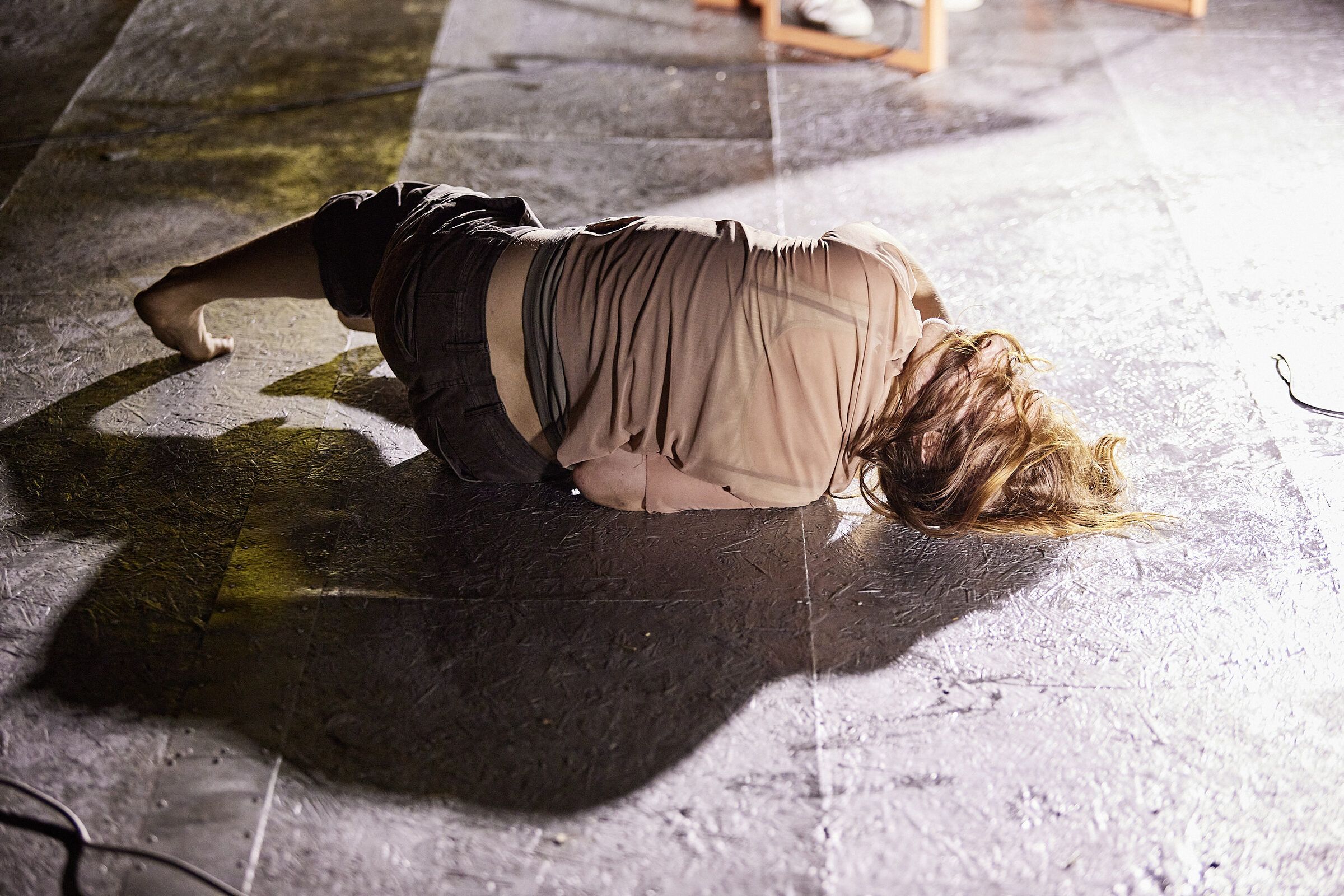
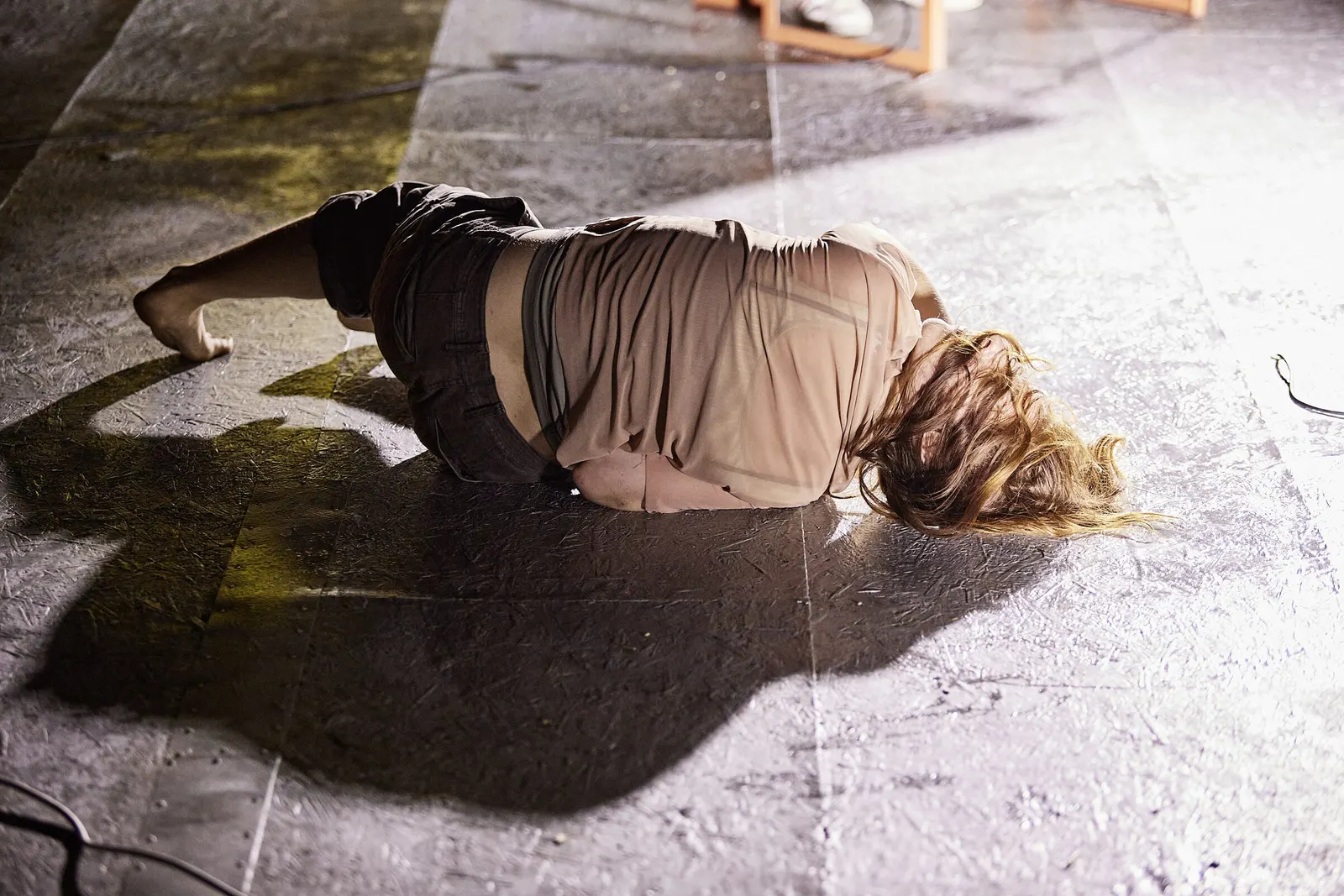
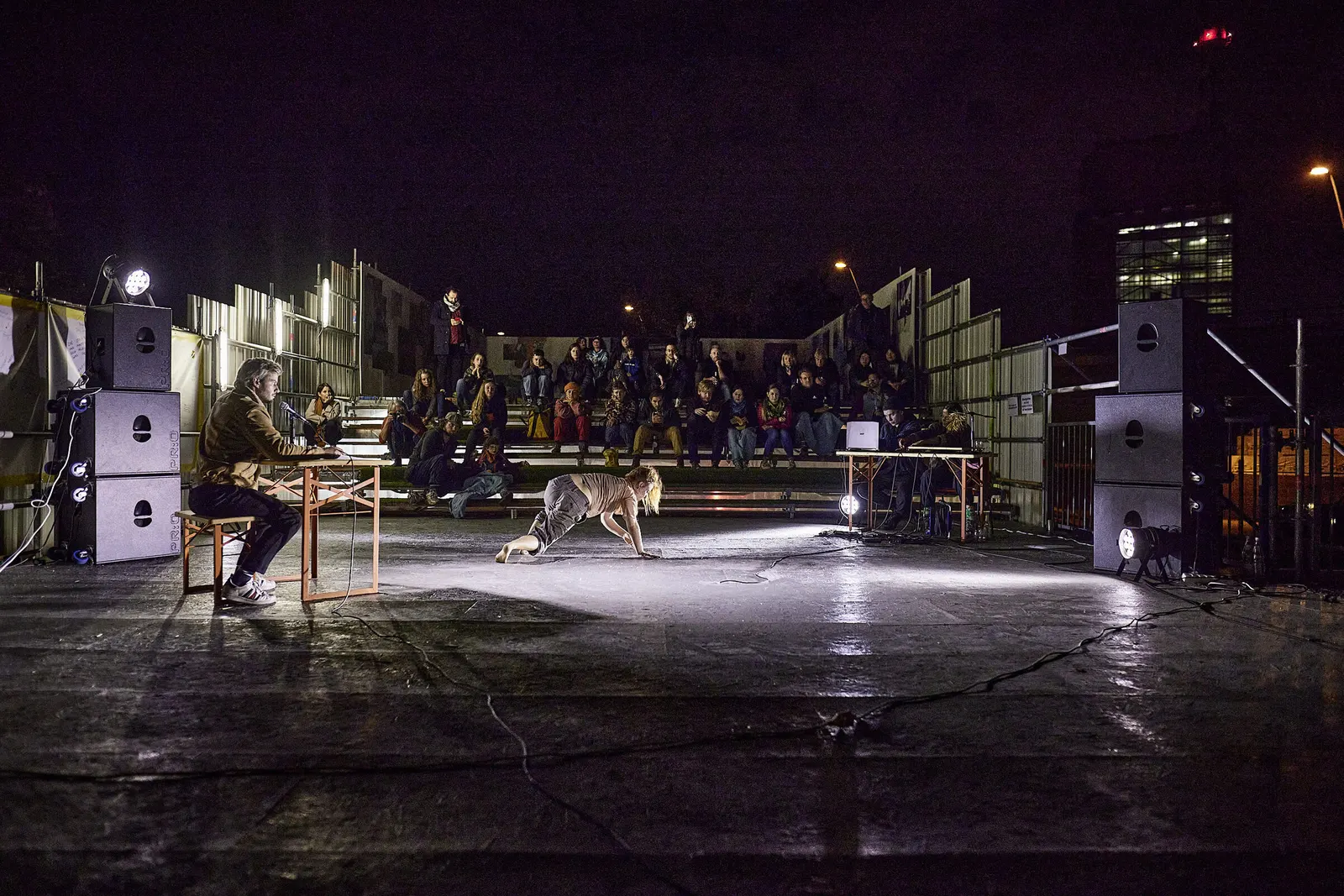
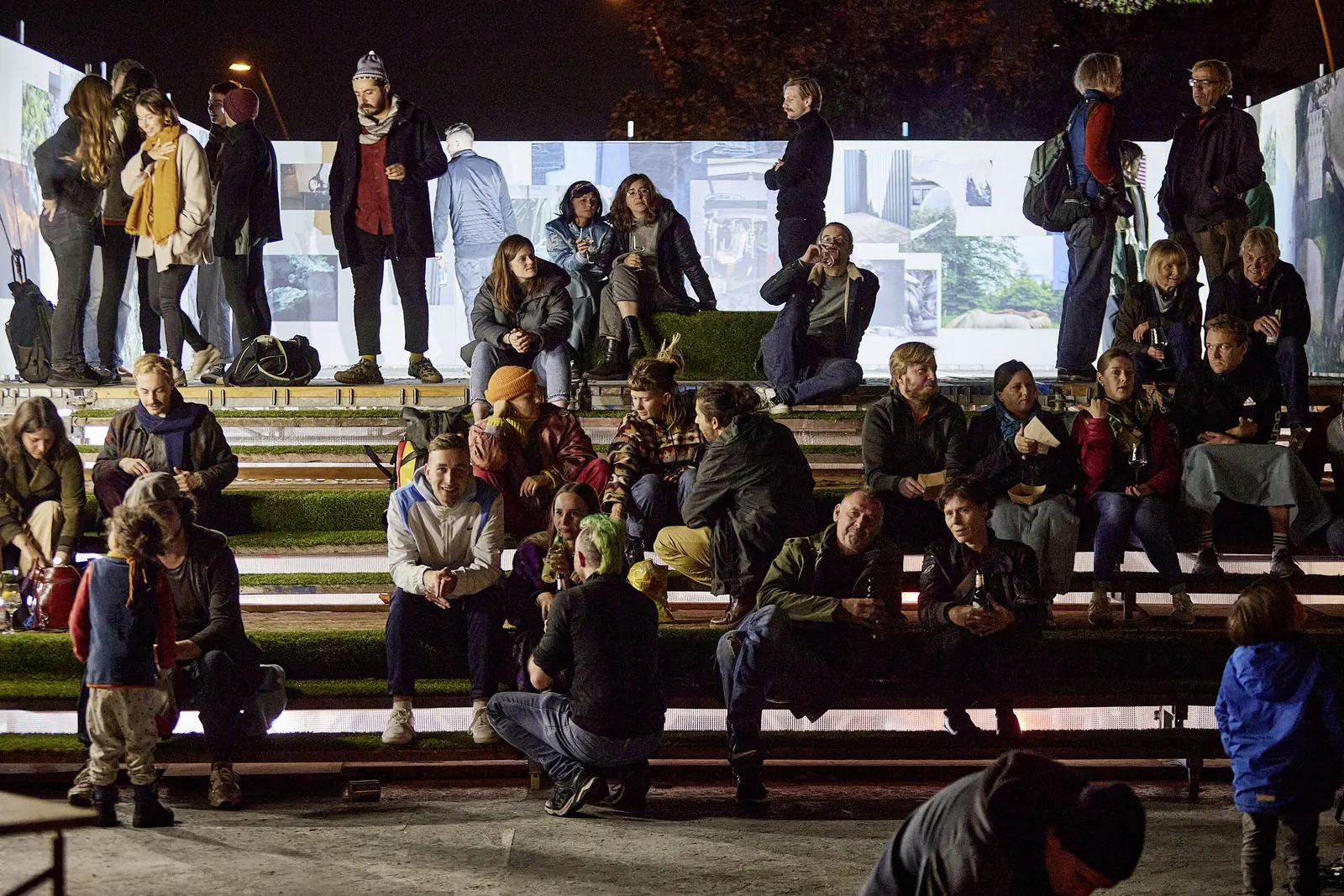
„Die Bretter, die die Bretter bedeuten“ 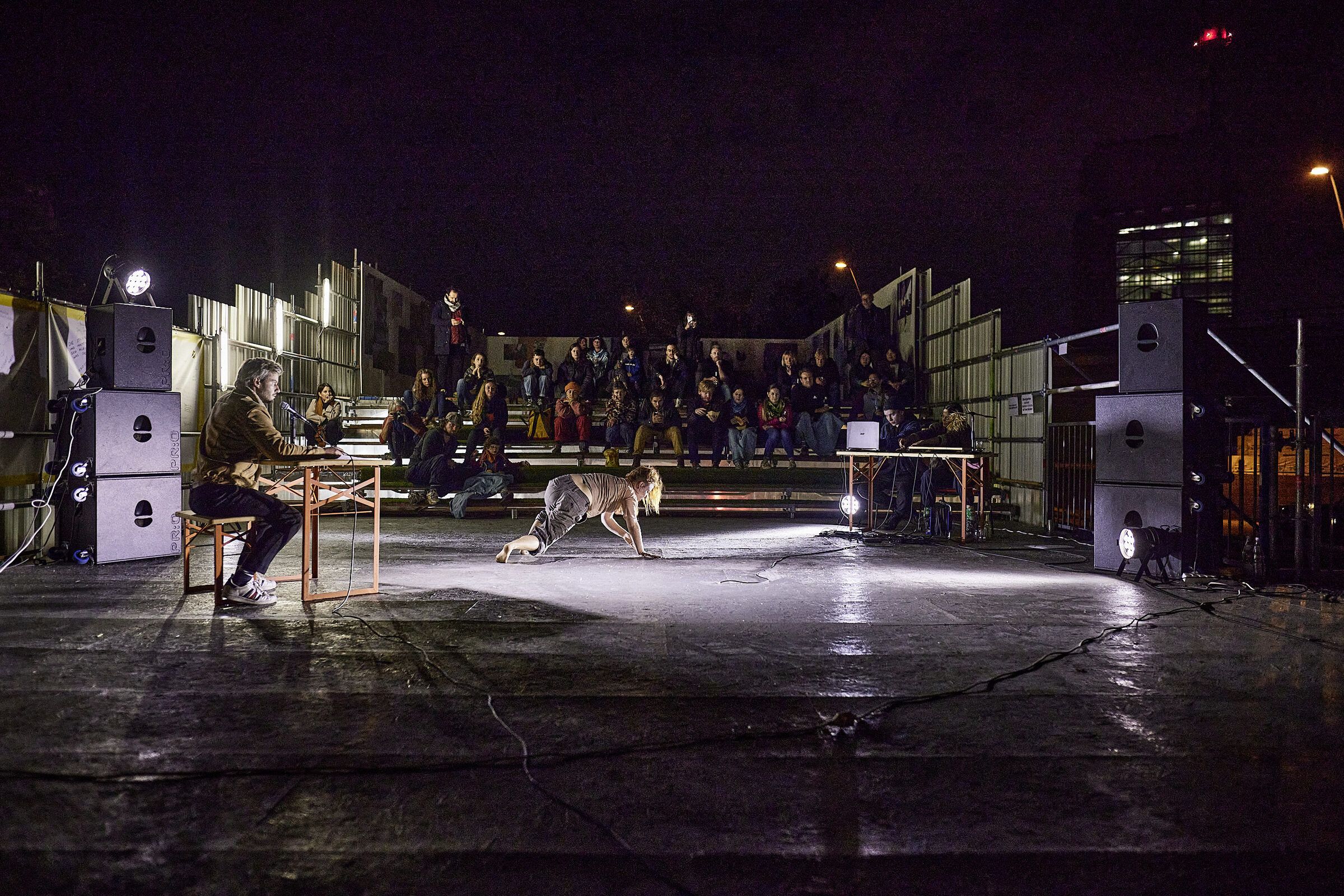
„Die Bretter, die die Bretter bedeuten“ 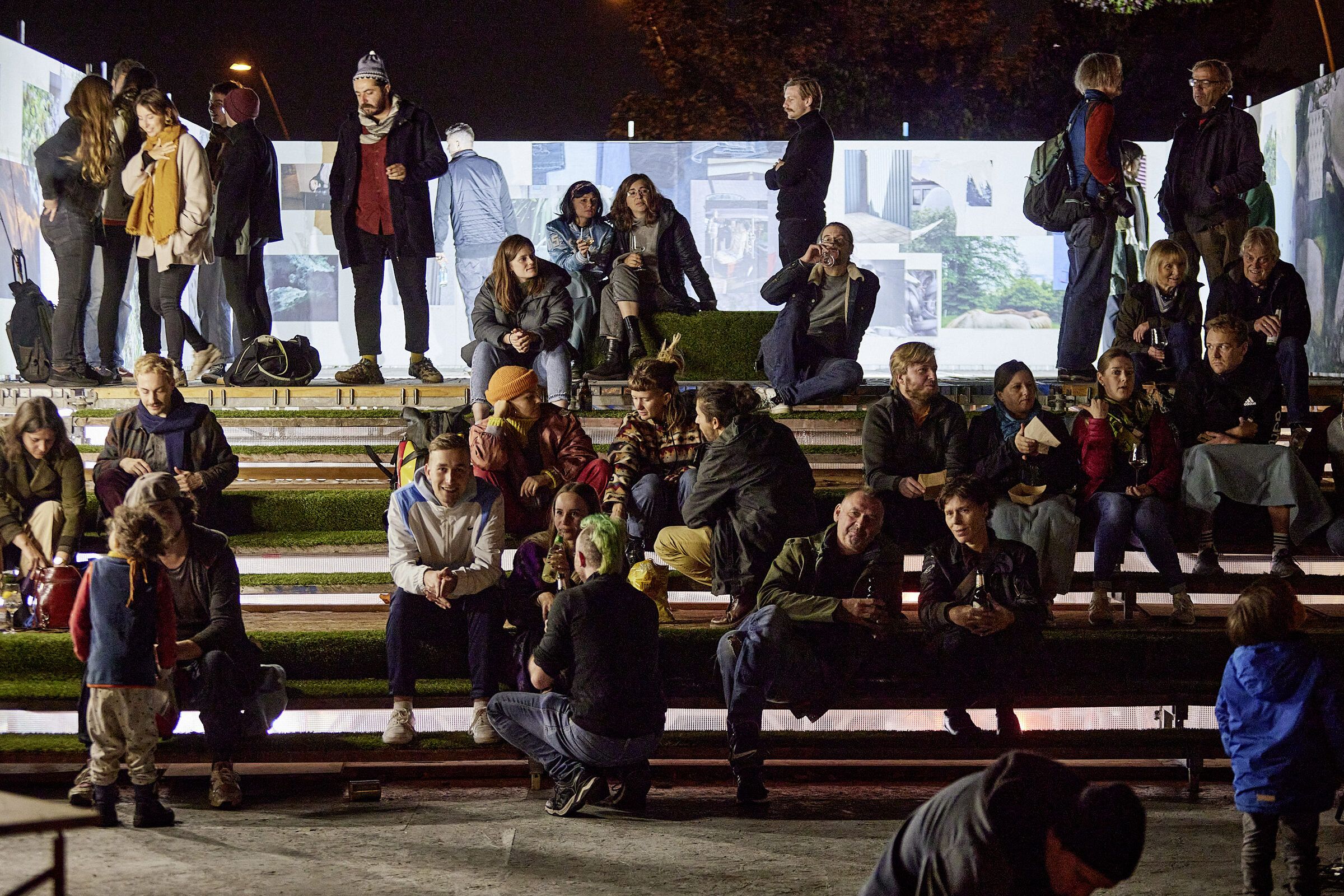
„Die Bretter, die die Bretter bedeuten“